
Library Manager
Manage your library—your way. Keep a running list or organize the books you've read into little stacks. i.e. Beach Reads, Cozy Covers, True Crime, etc.
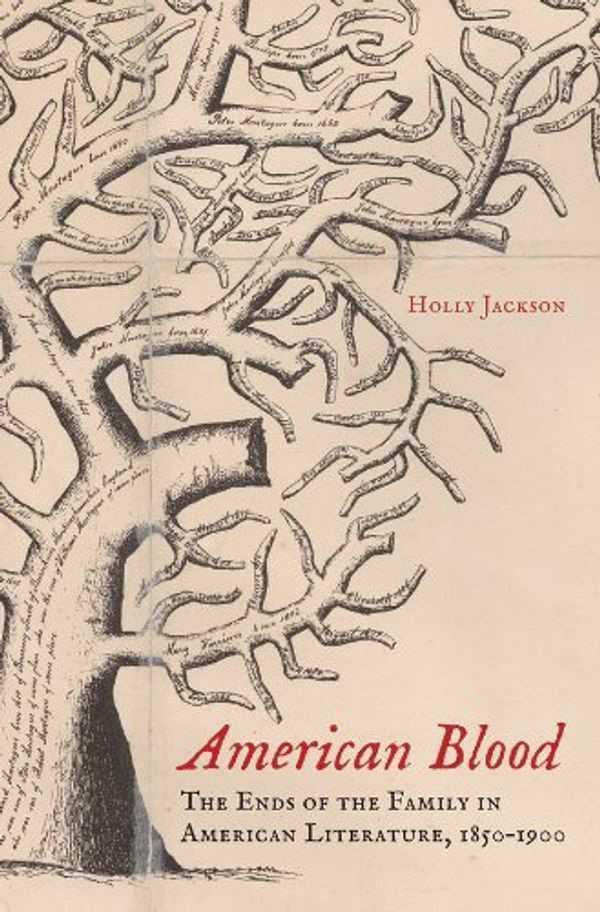
American Blood
A work of Non-fiction by Holly Jackson
Subgenres:
- Literary Criticism,
- Feminist Studies
This book is for you if you're into...
- Nineteenth-century novels that challenge the ideal of the family
- Literary criticism unpacking dark, political sides of domestic life
- Inventive readings connecting family dynamics to national anxieties
Conventional understandings of the family in nineteenth-century literary studies depict a venerated institution rooted in sentiment, sympathy, and intimacy.
American Blood upends this notion, showing how novels of the period frequently emphasize the darker sides of the vaunted domestic unit.
Rather than a source of security and warmth, the family emerges as exclusionary, deleterious to civic life, and antagonistic to the political enterprise of the United States.
Through inventive readings supported by cultural-historical research, Holly Jackson explores critical depictions of the family in a range of both canonical and forgotten novels.
Republican opposition to the generational transmission of property in early America emerges in Nathaniel Hawthorne's The House of the Seven Gables (1851).
The 'tragic mulatta' trope in William Wells Brown's Clotel (1853) is revealed as a metaphor for sterility and national death, linking mid-century theories of hybrid infertility to anxieties concerning the nation's crisis of political continuity.
A striking interpretation of Harriet Beecher Stowe's Dred (1856) occupies a subsequent chapter, as Jackson uncovers how the author most associated with the enshrinement of domestic kinship deconstructs both scientific and sentimental conceptions of the family.
A focus on feminist views of maternity and the family anchor readings of Anna E. Dickinson's What Answer? (1868) and Sarah Orne Jewett's The Country of the Pointed Firs (1896), while a chapter on Pauline Hopkins's Hagar's Daughter (1901) examines how it engages with socio-scientific discourses of black atavism to expose the family's role not simply as a metaphor for the nation but also as the mechanism for the reproduction of its unequal social relations.
Cogently argued, clearly written, and anchored in unconventional readings, American Blood presents a series of lively arguments that will interest literary scholars and historians of the family, as it reveals how nineteenth-century novels imagine-even welcome-the decline of the family and the social order that it supports.
Follow This Author
Join & we'll email you when a new title is available for pre-order or hits the bookshelf
Not Quite Dead Yet
2025


Five Survive
2022
As Good as Dead
2021
Kill Joy
2021

Good Girl, Bad Blood
2020





Get Free & Discounted eBooks
Curated reads, irresistible prices—subscribe now