I grew up in a conservative religious household in Utah. My parents and siblings are deeply principled people. But the heavy religious culture imparted strict gender roles and power hierarchies that have been difficult to remove from my psyche. I also metabolized the idea that there were good feelings and bad feelings. I avoided the “bad” parts of me, editing my thoughts, and suppressing ideas I knew would be condemned.
Yet, even early on, there was a resistance inside – a secret “no” to the life-path intended for me. And I very much wanted to see and experience the world.
I left home in my early twenties to study physics at Tufts University, and conducted high-energy particle physics research at Fermilab National Laboratory. It was around this time that I felt a compulsion to write – and started writing novels to process experiences that I couldn’t look at directly.
Those early manuscripts frustrated me. I was haunted by the sense that there were things about the world I didn’t see or fully understand. And I felt the inauthenticity - the internal blocks and prohibitions. Without meaning or wanting to, I was still subconsciously editing myself. Of course, I was in an environment that didn’t encourage sharing. I already felt unwelcome and strange as a woman in physics, and I’d internalized misogyny. I didn’t want to call attention to the already obvious differences, so I learned to hide my emotions and self-expression.
I finished my physics PhD in 2007 and, the following year, moved to Washington DC to begin work at The Center for Naval Analyses (CNA) – a federally funded Research and Development Corporation. CNA provides PhD brains to the U.S. military and government (think: Charlie in Top Gun). I helped write and run wargames, I conducted analysis, and deployed aboard Navy ships. My first deployment was aboard an Aircraft Carrier, the U.S.S. John C. Stennis. I also worked on a project that brought me to Naples for the first time - to the headquarters of U.S. Naval Forces for Europe and Africa.
In 2009, I served as an embedded analyst for twelve weeks aboard the antiquated USS Nashville on its pre-retirement voyage – as it shambled down the West African coast from Senegal to Gabon, training and working alongside local navies in a mission called Africa Partnership Station, or APS. This was a pivotal experience. I became committed to the work and to the people with whom I served. After that deployment, the Navy hired me to manage programmatic assessments for APS, and brought me to Naples from 2010 until 2013. APS was a unique mission with rare opportunities. I rode a fast-boat under a Liberian moon. I overnighted on the metal deck of a docked Landing Craft Unit, sleeping on collapsed cardboard boxes – and the next morning ran with the local troops and U.S. Marines through the jungles of Limbe. I scuba dived to the ocean shelf in Mauritius. I trained with Dutch special forces in Tanzania. I deployed aboard U.S. and European ships, and worked for weeks at a time in military bases in the Netherlands, Denmark, Spain, Senegal, Gabon, and Cameroon.
During this time, I fell in love with a brilliant submariner. We corresponded daily. He seemed to love my unfiltered thoughts, which encouraged me to share more. That relationship ended tragically, but the need to continue opening and discovering didn’t stop. I persisted, writing every day, digging into the pain and ugliness, trying to capture and understand the truth. Eventually, I shared my writings with a dear friend. It was vulnerable and terrifying. But I discovered that the pieces of me of which I was the most ashamed - she loved those the best.
Being loved in my complexity and brokenness gave me courage. I saw how I’d been using words to hide. I realized that I needed to understand and reveal myself through writing: to learn how to undress completely. To be naked on the page and not worry how I’d be perceived. Vulnerability took practice. I needed to stop judging my thoughts or emotions as “bad”, and get curious about them; to stay inside discomfort and shame and pain, and to ask what they could teach me.

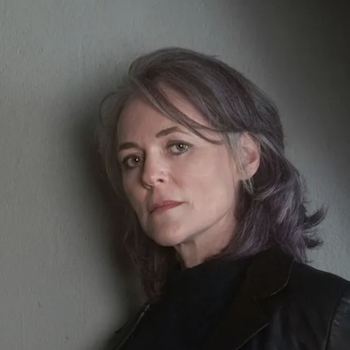
 with Elizabeth Heider